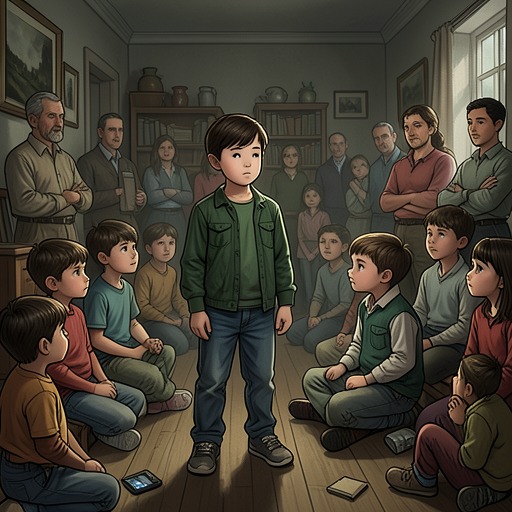
The Narrator Lies on the Tracks as a Train Passes Over Him
The Painted BirdThe Narrator Lies on the Tracks as a Train Passes Over Him is a repeated railway stunt in which the narrator lies between the rails while a train passes directly above him. What begins as a spectacle for other children becomes a private measure of survival: the approach of the engine concentrates his fear, while emerging unharmed gives him a powerful feeling of being alive.
Setting and Repeated Performance
The stunt takes place along the tracks near the orphanage, where trains pass close to the city on their way to and from the villages. On sunny days, the narrator and The Silent One walk over the sun-warmed crossties and sharp pebbles. If children from nearby settlements are playing beside the railway, The Silent One gathers them as an audience while the narrator prepares for the train.
A few minutes before it arrives, the narrator lies face down between the rails, folds his arms over his head, and makes his body as flat as possible. The suspense builds through physical sensation: he hears and feels the wheels thudding through the rails and ties until his own body shakes with them. When the locomotive is almost overhead, he presses himself lower and tries not to think. The furnace’s hot breath sweeps across him; the engine passes above, followed by the rattling carriages. He remains in place until the final car has gone.
The Fatal Precedents and the Meaning of Survival
The danger was not theoretical. The narrator remembered two boys killed while playing the same game in the villages. In one incident, burning cinders fell from the train as it passed over a boy, leaving his back and head badly burned; several witnesses claimed that the fireman had seen him and dropped the cinders deliberately. On another occasion, the couplings dangling from the last carriage were unusually long and struck the boy lying between the rails, crushing his skull. These deaths shadowed the stunt, making each performance an encounter with a risk the narrator already understood.
Yet that knowledge did not extinguish its attraction. In the brief interval between the locomotive and the final carriage, the narrator experienced life as newly pure and immediate. While the train thundered over him, the orphanage, his muteness, Gavrila, and The Silent One receded; what remained was the simple fact of being alive and unhurt. The ordeal’s danger gave that relief its force. Once the train had passed, he rose on trembling hands and weak legs, and the satisfaction exceeded even the pleasure he had taken in vicious revenge. He deliberately stored this feeling for future moments of fear and pain: measured against the terror of waiting for the train, other terrors seemed insignificant.
Aftermath, Recognition, and Repetition
Once the train had cleared the tracks, the performance’s public meaning emerged in the narrator’s unsteady body. He climbed from the embankment pretending to be indifferent, but his hands and legs trembled and the corners of his mouth were parched. The Silent One approached first, affecting a casual manner while brushing gravel and splinters of wood from the narrator’s clothes. The other children watched in a circle, admiring him. Their response turned a solitary encounter with mortal danger into a spectacle through which the narrator could claim recognition among his peers.
The two boys returned to the orphanage proud: the narrator knew that The Silent One was proud of him, and none of the other boys dared attempt the feat. They gradually stopped bothering him. That protection, however, depended on keeping the deed credible. The narrator understood that he had to repeat it every few days, or a skeptical boy might openly doubt his courage. He would press his Red Star against his chest, march back to the railway embankment, and wait again for the approaching train. The stunt thus worked both as a brief experience of being alive and as a recurring test imposed by the need to sustain his standing among the boys.
The Railway in Everyday Life
The train was part of the boys’ daily surroundings, not an occasional intruder: its morning whistle announced the peasants’ journey into the city with market produce, and in the evening its lit windows receded between the trees on the return to the villages. The Narrator and The Silent One also spent time on the tracks watching trains pass and sometimes jumped onto the steps of the rear cars, getting off when a train slowed at the crossing. Against this routine familiarity, lying between the rails turned the railway from a route they knew into a deliberate test of bodily survival.